

Okay Isn’t Good Enough
On why ‘okay’ is the most dangerous place to be in trading

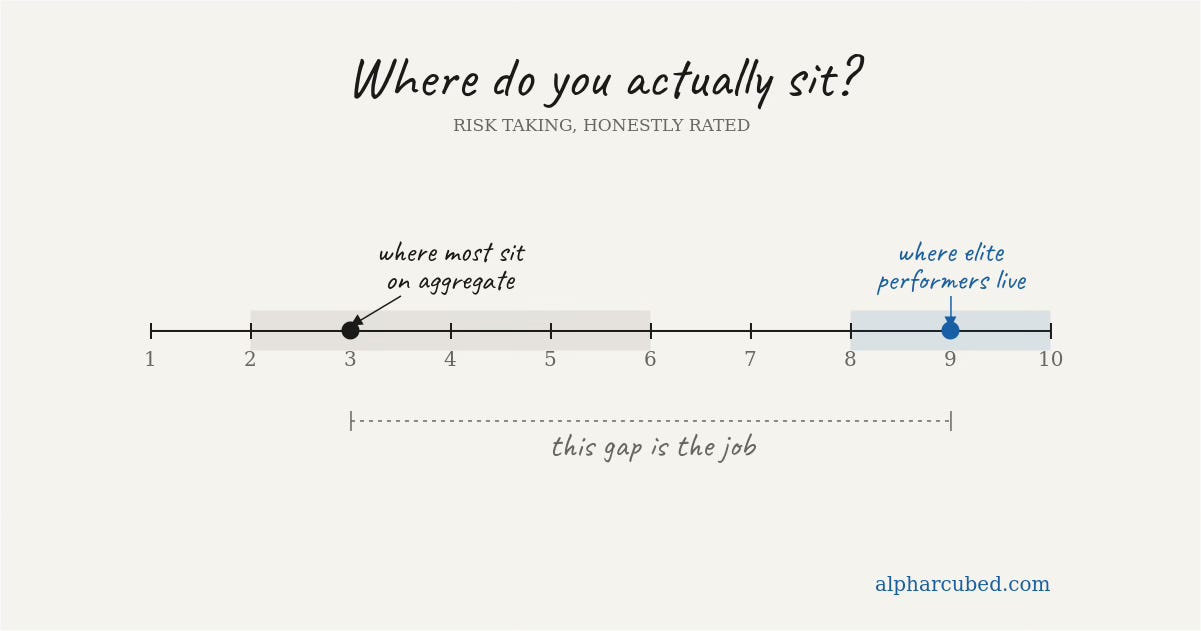
At the crux of trading is risk taking. At the crux of succeeding at trading is becoming better at risk taking.
Obvious, isn’t it. Almost too obvious to write down.
And yet almost nobody does the work to actually become a better risk taker. Instead they do more analysis. They refine their systems. They dig deeper into the data, convinced that the next model, the next edge, the next dataset is where the improvement lives.
All of it is deflection. A very sophisticated, very time-consuming way of avoiding the actual and rather painful truth.
The problem is most people don’t know where else to go. Analysis has a process. Data has a process. “Becoming a better risk taker” doesn’t come with a manual, so people retreat to the thing that does.
A story I’ve told before
Thirteen years into my career, working at investment banks in London, I thought I was good at trading. I’d been promoted. I’d had some very strong periods and a few poor ones, self-doubt and confidence, the normal rhythm of the job. My conclusion, most of the time, was that I just needed to pull my socks up.
Then I went through a coaching programme, and it caused me to reflect deeply on a few things that came up in it. And it struck me: I wasn’t actually that good at taking risk. - And yet my job was ‘taking risk’!
I was okay at it. But okay doesn’t cut it. Okay got me to where I was, but it wasn’t going to take me any further. In trading, elite sports, generally, you don’t stand still. You either move forward, or you start slipping backwards.
Okay got me to where I was, but it wasn’t going to take me any further.
Go and look at elite athletes. Plenty of people are okay. But those who are okay don’t make it very far, and they rarely sustain a successful career in it. Even at the pro level, you might make a few glorious appearances, but okay won’t get you anywhere near the podium. Getting there takes something well beyond technical acumen. Mindset. Assuredness. Self-alignment. Self-belief. Self-awareness. Self-trust. Self-confidence. Self, self, self. Ultimately, it’s all about the self.
Risk taking in trading is no different.
What I actually found
Being brutally honest with myself, I was caught in a cycle of avoidance, excuses, blame, deflection, and identity preservation, all in service of protecting my previous sense of self, and the ego attached to it.
That’s the bit nobody tells you. Risk taking isn’t a technical skill sitting next to your market knowledge.
Instead it’s largely about the quality of the relationship you have with yourself, in the moment, under uncertainty, under scrutiny, both from others and from yourself. Sure, you need the technical grounding; you need to know the market and the trade. But at the core it comes down to who you are, how you’re being, and how willing you are to trust yourself with the risk in front of you.
Where do you actually sit?
How would you honestly rate yourself as a risk taker, in the way that’s actually required for the type and style of trading you do? Ten out of ten is off the table. Perfection isn’t on offer. But what could you realistically be? An eight, a nine? What would you be happy with? And what score would you need to hit, consistently, to actually see the success you want showing up in your results?
Then the harder question. Where do you actually sit right now? Not on the good days. On aggregate, across the good and the bad. A three? A four? A five? If you’re not at an eight or a nine, what are you doing about the gap?
Here’s my own honest reflection from that time. With regard to my analysis as a trader, I’d argue I was and eight, maybe close even to a nine. I was a good analyst. But as a risk-taker? Somewhere close to a two or a three. I had good periods, and I was a senior trader at a major investment bank, so from the outside I probably looked far better than I actually was. But what I think was really happening was I was preserving my identity, holding out in the hope I wouldn’t be found out, and actually avoiding real risk taking altogether.
The good thing about falling that short, however, was there was massive room for improvement. And having recognized it, and been honest with myself about tit, that’s what I started to work on, and towards.
This piece isn’t the answer
This week’s newsletter isn’t meant to resolve anything, it’s just here to poke, provoke, and evoke. To make you think. It’s meant to needle you a bit. Whatever level you’re at, whether you’re struggling or already doing well, the real battle never changes: getting better and better at taking risk.
There are different styles of risk taking, and we’ll get into those another time. But start here, be honest with yourself: are you actually present when you take risk, or are you managing your own comfort instead?
So sit with that for now, and reflect on yourself.
I look forward to continuing to exploring the game of trading with you in upcoming newsletters.
Steven Goldstein
Author of Mastering the Mental Game of Trading · Buy the book
Coaching enquiries: info@alpharcubed.com
Hi Steven,
Great to connect! I've really enjoyed your work on the psychology of trading. Your focus on discipline, self awareness, and mastering the mental side of trading offers a perspective that's often overlooked.
I also write about fintech, crypto, blockchain, digital banking, and payments, with a focus on the technologies and infrastructure shaping the future of finance. I've subscribed to your Substack and look forward to learning from your insights.
I'd love for us to support each other's work by subscribing and engaging with our content. If there's an opportunity to collaborate down the line, I'd be happy to explore it.
It's like you read my mind! This is exactly what I was thinking about more this week. Thank you as always for the insights and further prompt.