

Strong Opinions, Weakly Held


Strong Opinions, Weakly Held is a vital maxim for trading. It reminds us that while we need conviction and clear narratives to engage with the market, we must always hold those views loosely. The market is a complex, emergent, and radically uncertain environment. At best, our perspective is a probability call. But hold an opinion too close, and it becomes your identity.
When I became my Strong Opinion
My trading career was progressing well, I had achieved some great success trading, and on the back of a strong year, I was asked to join a new Proprietary Trading desk being set up at Credit Suisse in London.
This was the mid-1990s, the height of the burgeoning Prop Desk scene in London banks, the forerunner of much of what became the hedge fund industry. We were given free licence to trade a vast array of products and markets, with real freedom and in sizeable risk amounts.
My confidence was high. I’d produced strong performance over the previous couple of years, and I believed in my ability to keep doing so. To a degree, I felt unstoppable. That, as I would later understand, was the first warning sign.
As I entered the new year, I was scanning for ideas, watching markets, reading research, looking for trades with strong risk-reward set-ups. I developed a view that the US stock market was running into resistance, top-heavy after a year of rising interest rates. I started building a put option structure to capture a downside move in the index.
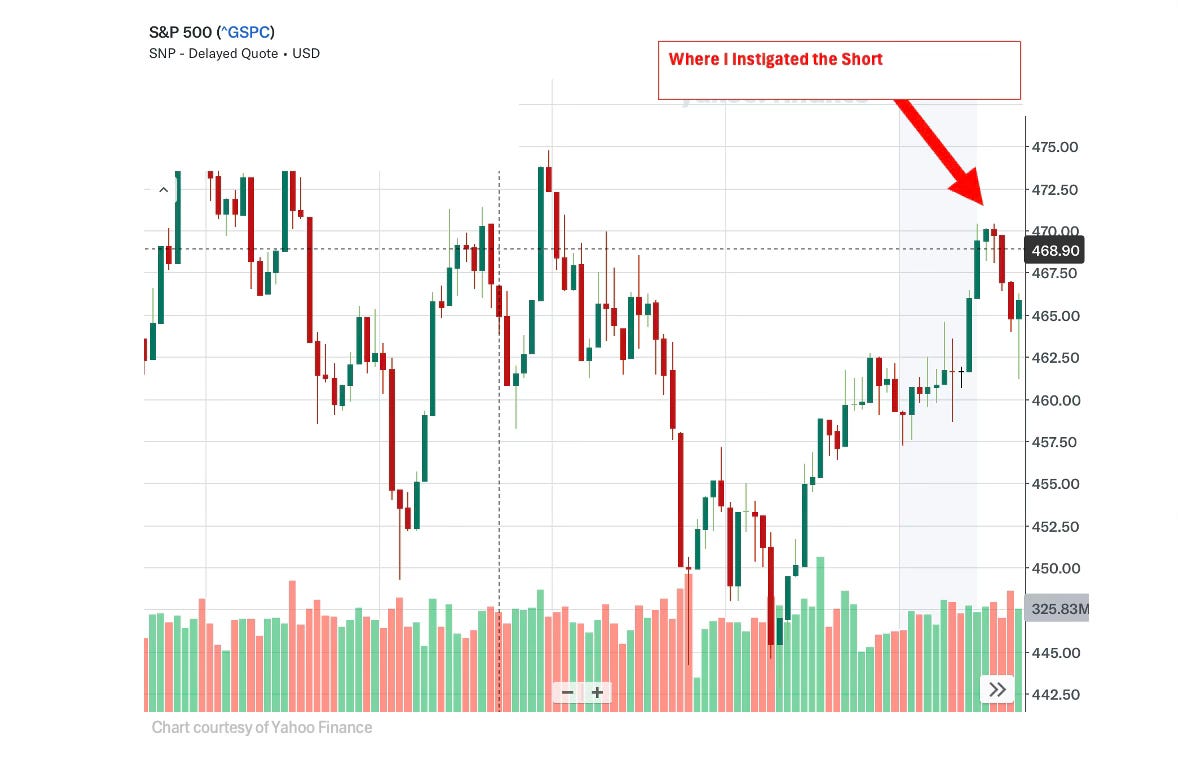
The trade immediately went my way. Within days, the index dropped around 2%. It looked good, very good. In today’s context, that’s an immediate 150-point drop. And that’s when a more dangerous thought crept in: this is the trade that’s going to make my year.
That should have been a red flag. The moment you think like that, you begin to attach your value, your identity, your future, to a particular outcome. And when that happens, you and your opinion start to quietly merge.
On the daily chart of the S&P 500 in January 1995, you can see roughly where I shorted and the immediate move that followed.
But looking back, I was being set up. The sharp move fizzled-out and reversed quickly. The option strategy returned to breakeven.
I told myself it was just a pullback before the bigger move lower.
Then the market started to move against me. I went back to the research and reports I had read. Their authors were convinced this was temporary, that the real sell-off was coming. I found comfort in that. What I didn’t see at the time was that I was now deep in confirmation bias, actively seeking out voices I knew already agreed with me.
My ego was satisfied. My opinion was reinforced. And without realising it, the distance between me and my view had closed entirely.
In the weeks ahead, the market moved against me with increasing vigour. The doubts that should have surfaced manifested instead as stubbornness. I held on when clarity would have told me to get out. I thought I was keeping my pain hidden, but you can’t hide pain. My colleagues could see it.
Then one day, one of them said: “Steve, why don’t you just get out? It’s clearly not working. Close it down and accept you were wrong.”
My response still makes me wince: “I’m not wrong. The market’s wrong.”
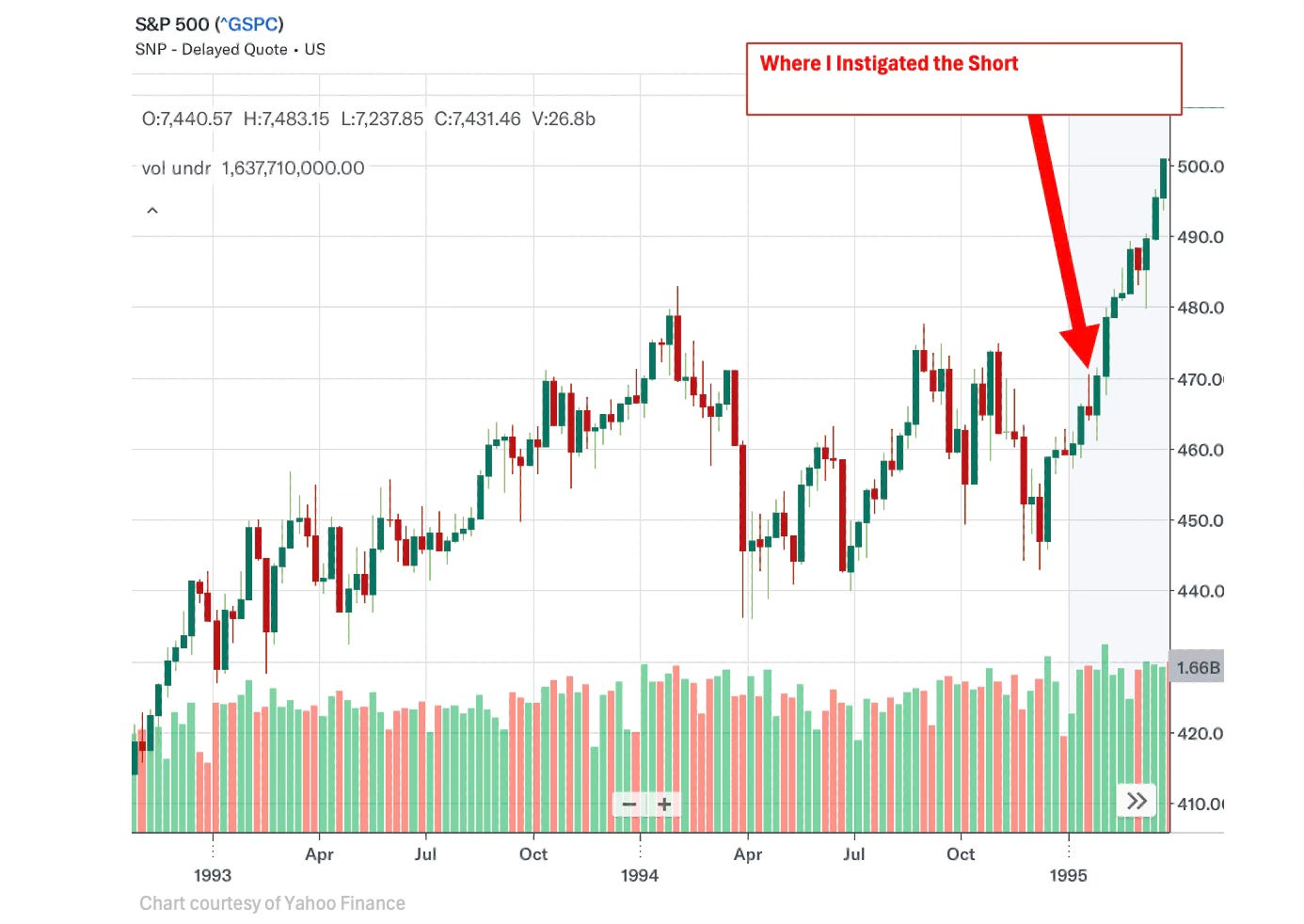
When I finally exited, the loss was significant. Not catastrophic on paper, but psychologically I was in a very bad place. Every trade that followed over the coming weeks and months bore the scars: hope trades, revenge trades, poor calls, and even worse risk management. The losses mounted. And it all began with a Strong Opinion that I had refused to hold weakly.
Why Did It Feel Like an Attack?
I have reflected on that moment, my colleague’s advice, my reaction, more times than I can count. And the question that keeps returning isn’t how did I lose so much? but why did being told I was wrong feel like such a personal threat to my self?
He was obviously right. The evidence was plain. So why did his suggestion feel less like useful advice and more like an assault?
That question has a real answer, and it comes from an unexpected place.
What Was Actually Happening
In the psychological framework that underpins my coaching work, what I experienced maps cleanly onto a concept from Gestalt psychology called Confluence.
In healthy trading, and in healthy thinking of any kind, there is a clear boundary between you and your opinions. You hold a view. You can examine it, question it, update it, release it. You and it remain separate things.
In Confluence, that boundary dissolves. You no longer hold the opinion. You are it. When that happens, any challenge to the view stops feeling like new information and starts feeling like a personal attack. There is no longer any gap between you and what you think, which means there is no space for fresh data to land, no room for doubt to surface, no possibility of changing your mind without feeling like you are losing yourself.
This is why I said what I said. I wasn’t being stubborn for the sake of it. I was defending my identity, because at that point my identity and my trade position had become one and the same thing.
For traders, this is lethal territory. Confluence with a position or market view is precisely the state that stops loss-cutting, distorts incoming information, and turns a trade into an ego statement. When you are the opinion, you enter a closed loop that endlessly confirms itself. In trading, that loop has a name: the death spiral.
I explore all of this in much greater depth in Mastering the Mental Game of Trading, where I introduced the Performance Process Cycle as a practical framework for catching these psychological traps before they take hold. It grew directly out of experiences like the one I’ve just described, and the years of coaching work that followed.
How Great Traders Do It Differently
If you’ve spent time around serious traders, you’ll have heard the phrase Strong Opinions, Weakly Held. It was brought into sharp focus for many by Jack Schwager’s interview with Peter Brandt in Unknown Market Wizards, where Schwager used it as the chapter title. Brandt spoke candidly about how central it is to his approach: hold your views with conviction, but keep them loose enough to release when the evidence demands it.
Simple to say. Remarkably difficult to do, because it runs directly against some of our most basic human instincts.
The antidote is to get ahead of it, and it begins with how you come to your work at the very start of any trading process. You must turn up in the right frame of mind, being genuinely open: no predetermined bias, no attachment to outcome, a real curiosity about what the market is actually saying rather than what you want it to say. Humble. Objective. Present.
The difficulty is that we can lose that openness at any moment. The drift from conviction into confluence can happen so gradually that you don’t notice it until you are already trapped. Which is why Strong Opinions, Weakly Held isn’t just trading advice. It is a form of psychological hygiene, the ongoing discipline of keeping a clear boundary between what you think and who you are.
The Market Simply Is
There is one more idea I want to leave you with, and in some ways it is the foundation beneath everything else written here.
I said earlier that I told my colleague the market was wrong. I’ve thought about this phrase many times since. It reveals something important, not just about my state of mind in that moment, but about a misunderstanding that many traders carry without realising it.
The market is neither wrong, nor right, ever. It doesn’t have an opinion. It doesn’t know your name, your position, or your pain. It is not conspiring against you, rewarding you, not setting traps despite what I wrote earlier. Those traps are set by us, for us. That’s why we talk about ‘self sabotaging’ so often. No, the market simply is.
When I said the market was wrong, I was doing something very human but very costly. I was projecting onto it. I was treating it as an adversary that had made an error, rather than an environment I had failed to read clearly. That framing let me stay in the trade, because if the market was wrong, all I had to do was wait for it to correct its mistake. It never did. It never does. Because it doesn’t make mistakes. It just is.
Strong Opinions, Weakly Held. Not as a technique, but as a way of being.
That, is the whole game.
I look forward to continuing to explore this game with you in upcoming newsletters.
Steven Goldstein
Author of Mastering the Mental Game of Trading · Buy the book
Coaching enquiries: info@alpharcubed.com
Great post Steven. That was a line I heard from Peter Brandt many years ago, “strong opinions, weakly held” that always stuck with me. As part of my pre-trade pre-mortem I like to think about what do I need to see to know I’m wrong in this idea; and how quickly can I found out this idea is wrong so I can cut it, and move on. It has helped me enormously.
Value Based Inputs,helped to encash opportunities cum options to move forward.